Essays in Metaphysics by Martin Heidegger
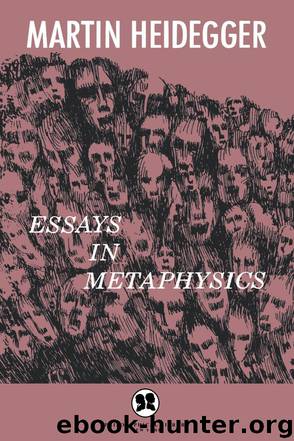
Author:Martin Heidegger [Heidegger, Martin]
Language: eng
Format: epub
Publisher: Kensington Publishing Corp.
Published: 2013-10-08T16:00:00+00:00
Concerning the Second Question
For Hegel, the criterion for the discussion involving the history of philosophy is the degree of penetration into the vigor and milieu of that which was thought by former thinkers. It is not by chance that Hegel establishes his maxim in the course of his conversation with Spinoza and prior to a discussion with Kant.38 In Spinoza Hegel discovers the perfect “point of view of substance,” which, however, cannot be the highest because Being has not been thought of as yet to the degree and absolutely fundamentally as self-thinking Thought. Being, as substance and substantiality, has not yet unfolded itself as subject in its absolute subjectivity. Nevertheless, Spinoza is stimulating the entire thinking of German idealism again and again and immediately generates a contradiction because he has Thought start with the Absolute. The way of Kant, on the contrary, is different and one that is by far more decisive for absolutistic idealistic thought and for philosophy in general than the system of Spinoza. Hegel sees in Kant’s idea of the original synthesis of apperception “one of the profoundest principles for speculative development.” 39 The relative influence of thinkers Hegel discovers in what they thought in so far as it may be raised to the appropriate stage of absolute Thought. Thought becomes absolute only by virtue of the fact that it moves in its dialectic-speculative process and requires for it an appropriate graduation.
For us, the criterion in our discussion involving historical tradition is the same in so far as it is a matter of penetrating the vigor of prior thinking. However, we are not looking for vigor in what has already been thought, but in something that has not yet been thought. It is in this something which provides thought with the sphere in which it has its being. Still it is what has been thought that first prepares the way for the not-yet-thought which enters again and again with its overabundance. The standard for that which has not yet been thought does not lead to an incorporation of what has previously been thought into a still higher development and systematization which outdistances it, but demands the release of traditional thinking into the past which is still preserved. Originally, the past controls tradition throughout and constitutes its anterior being without being thought of specially as and in terms of a beginning.
Download
This site does not store any files on its server. We only index and link to content provided by other sites. Please contact the content providers to delete copyright contents if any and email us, we'll remove relevant links or contents immediately.
| Anthropology | Archaeology |
| Philosophy | Politics & Government |
| Social Sciences | Sociology |
| Women's Studies |
The remains of the day by Kazuo Ishiguro(8999)
Tools of Titans by Timothy Ferriss(8396)
Giovanni's Room by James Baldwin(7346)
The Black Swan by Nassim Nicholas Taleb(7129)
Inner Engineering: A Yogi's Guide to Joy by Sadhguru(6796)
The Way of Zen by Alan W. Watts(6614)
The Power of Now: A Guide to Spiritual Enlightenment by Eckhart Tolle(5781)
Asking the Right Questions: A Guide to Critical Thinking by M. Neil Browne & Stuart M. Keeley(5775)
The Six Wives Of Henry VIII (WOMEN IN HISTORY) by Fraser Antonia(5515)
Astrophysics for People in a Hurry by Neil DeGrasse Tyson(5190)
Housekeeping by Marilynne Robinson(4447)
12 Rules for Life by Jordan B. Peterson(4304)
Ikigai by Héctor García & Francesc Miralles(4274)
Double Down (Diary of a Wimpy Kid Book 11) by Jeff Kinney(4272)
The Ethical Slut by Janet W. Hardy(4253)
Skin in the Game by Nassim Nicholas Taleb(4248)
The Art of Happiness by The Dalai Lama(4130)
Skin in the Game: Hidden Asymmetries in Daily Life by Nassim Nicholas Taleb(4007)
Walking by Henry David Thoreau(3962)
